 The Hosting Lexicon
Domain name or web host? The difference
The short version
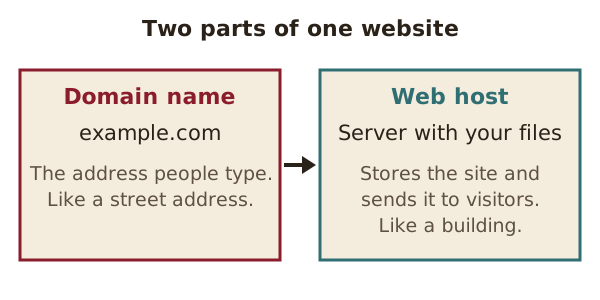
- A domain name is the address people type, such as example.com. A web host is the company and the computer that store your site's files and send them to visitors.
- You need both. The name without a host leads nowhere.
- They are usually sold separately, and you can change one without the other.
Two different jobs
A domain name is a human-readable address for a web server on the internet.[1] Computers find each other by number, and those numbers are hard to remember and can change.[1] The name is the easy label that stands in for them.
A web host does the storing and sending. A web hosting service provides the infrastructure needed to host websites and make them reachable on the World Wide Web.[2] The files for your pages sit on the host's server.
Think of a shop. The domain name is the street address on the sign. The host is the building, with the shelves and stock inside. An address with no building behind it is just a sign.
Who provides each one
You can't "buy" a domain name outright. You pay for the right to use it for one or more years.[1] Companies called registrars work with registries to keep track of who holds each name.[1]
A web host is a different kind of company, with servers. Some companies sell both. They are still two separate services, and each has its own renewal. Hosting plans also have their own prices and limits (see Plans and billing terms).
How the two get joined
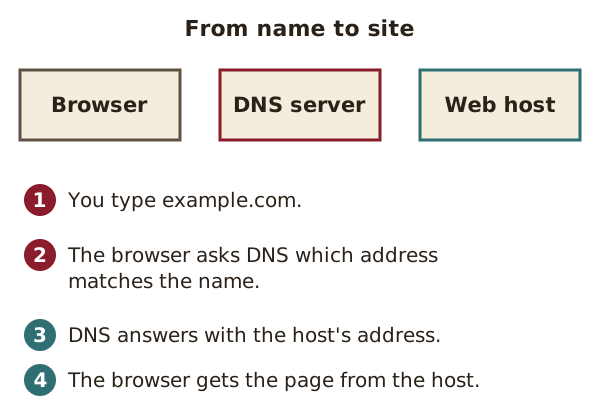
A name and a host only work together once they are linked. The link is made in the Domain Name System, or DNS. Setting it up means defining the site's name and pointing it at the hosting server.[2]
Here is what happens when someone visits. Their browser asks a DNS server which address matches the name.[1] The answer leads to the host's server. That server can be reached through the domain names of the sites it stores.[3]
The records that make this link are a topic of their own, and this site doesn't cover them.
Why the split is useful
Because they are separate, you can move one without losing the other. You could keep example.com at the same registrar and move the site's files to a new host. Visitors keep typing the same name.
It also means each part can be changed alone. If you're unhappy with a host, the name is still yours to point somewhere else. For moving a site, see Migration.
Common mix-ups
- "Hosting includes my domain." Not always. Check whose name the domain is registered in, and when it renews.
- "My domain is my website." No. The name is only the address. The site is the files on the host.
See also: Web host · Web server · Migration.
Sources
- What is a Domain Name? (MDN), MDN Web Docs (accessed 2026-10-27)
- Web hosting service, Wikipedia (accessed 2026-10-27)
- What is a web server? (MDN), MDN Web Docs (accessed 2026-10-18)