 The Hosting Lexicon
Cloud service terms
The short version
- Cloud companies sell three kinds of service, named by how much they run for you: IaaS, PaaS and SaaS.
- A virtual machine is a pretend computer. A container is a lighter way to keep programs apart.
- The "aaS" in each name means "as a service".
Infrastructure as a service (IaaS)
IaaS means you rent the basic building blocks, such as virtual machines and storage.[1] They come from the provider's large pools of equipment.
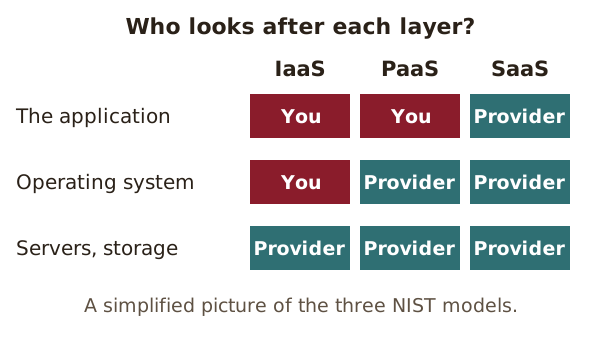
You then choose the operating system and install your own software. In this model, the cloud user patches and maintains the operating systems and the application software.[1] "Patching" just means installing fixes.
Billing follows use. Providers typically bill IaaS on a utility computing basis, like electricity.[1]
IaaS is the cloud service closest to a VPS that you run yourself. See also Unmanaged hosting.
Platform as a service (PaaS)
PaaS sits one step up. You bring your code, and the provider supplies the place it runs.
Developers run their software on a cloud platform instead of buying and managing the hardware and software layers underneath.[1] The operating system is not your job.
So a small team can publish an app without ever logging in to a server. The trade-off is that you can only use the tools the platform offers.
Software as a service (SaaS)
SaaS is a finished program that you use over the internet. The provider runs all of it.
Cloud providers manage the infrastructure and platforms that run the applications.[1] You use the program through something like a web browser, and web-based email is the example the NIST definition gives.[1]
It is usually priced on a pay-per-use basis or with a subscription fee.[1]
Virtual machine
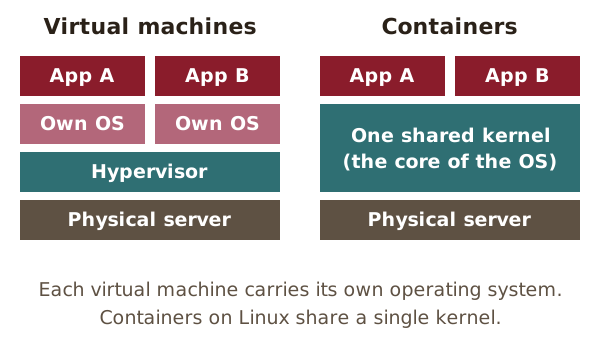
A virtual machine (VM) is a software copy of a whole computer. It acts like a real one, with its own operating system.
A program called a hypervisor runs the virtual machines as guests.[1] One physical server can hold many of them. That's how a provider hands out many separate servers from a few big ones. See Hypervisor.
Container
A container keeps one program apart from the others, but without a whole operating system for each.
On Linux, containers run in isolated partitions of a single Linux kernel.[1] The kernel is the core of the operating system. All the containers share it.
That makes containers lighter. They perform better than virtual machines because there is no hypervisor overhead.[1] The cost is less separation, since the kernel is shared.
Where the names come from
NIST, the US standards body, recognised the three service models in 2011.[1] For the full story of cloud hosting, see Cloud hosting and the history of web hosting.
Sources
- Cloud computing, Wikipedia (accessed 2026-10-24)